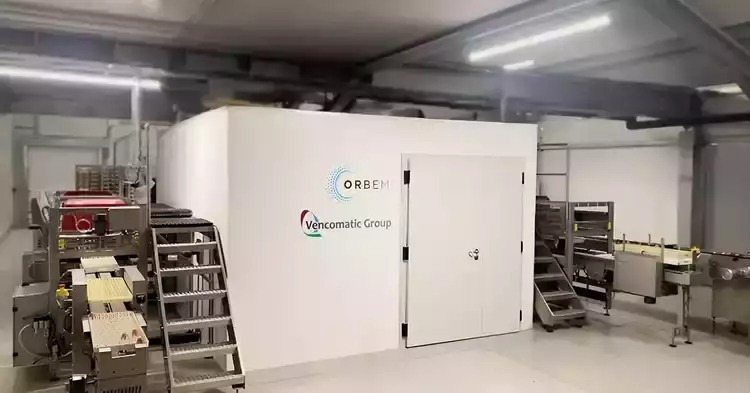
With support from EIT Food, Orbem moved from early experiments to a commercial system that raised €30 million and now supports more than 150 employees.
Orbem began as a research project and is now a fast growing company using AI imaging to help hatcheries make cleaner and kinder choices. The Team began as a research project and is now a fast growing company using AI imaging to help hatcheries make cleaner and kinder choices.
How One PhD Student Ended Up Brooding Over Billions Of Eggs
When Miguel Molina Romero started his PhD, he never planned to build a company. He wanted to solve a problem affecting billions of eggs handled every year, a problem that had shaped the poultry sector for decades. His research into high speed, non invasive egg imaging became the starting point for what would evolve into Orbem.
A Hard Shell To Crack
The poultry sector depends on fast, accurate decisions. Hatcheries handle millions of eggs each week, and they need information that fits the pace of industrial lines. For decades, the industry lacked a practical way to understand what was happening inside each egg early enough to act on it. Without this insight, hatcheries faced both welfare challenges and unnecessary operational losses.
The problem sat at the intersection of welfare, regulation, and efficiency. Producers needed a tool that could classify an embryo early in incubation, run at full hatchery speed, and fit into existing equipment without disrupting workflow. Until Orbem, no available solution met all three needs at once.
Hatching The Future
Orbem has delivered several major milestones that show the strength and scalability of its technology. The company has installed systems that help producers meet legislative deadlines in countries phasing out the culling of day-old male chicks. Its platform provides fast, accurate sex identification early in incubation and can operate at the throughput required by commercial hatcheries.
In 2023, Orbem raised €30 million, one of the largest deep tech investments in the European agrifood sector that year. The funding accelerated manufacturing, supported global expansion, and strengthened engineering, biology, and hardware teams. Today, Orbem employs more than 150 specialists across machine learning, imaging physics, hardware design, and commercial operations.
The platform has also shown strong versatility. Its contactless imaging can support other sectors that need high speed, non destructive analysis, positioning Orbem as a deep tech company with potential far beyond poultry.
EIT Food Support To Orbem
Orbem’s journey through the EIT Food ecosystem began in 2018, when Miguel Molina Romero joined the Global Food Venture Programme during his PhD. This programme gave him the first structured pathway to explore the commercial potential of his imaging research. It introduced him to experienced mentors, entrepreneurial training, and early stage business development tools.
In 2019, Miguel entered the EIT Food Seedbed Incubator, and through it was able to explore market assumptions, validate producer needs, and pressure test the idea with hatcheries and industry partners. The Seedbed played a key role in refining the value proposition and confirming that non-invasive in ovo sexing had real market demand.
In 2019, the Orbem team progressed into the EIT Food Accelerator Network (FAN). FAN provided access to technical experts, industrial partners, and specialised support in scaling deep tech solutions. Through FAN, Orbem completed key validation work that demonstrated its platform could handle industrial throughput. This stage also strengthened the company’s engineering and regulatory readiness and was a vital step to helping them prepare for the external investment they would go on to receive.
Miguel’s journey through EIT Food’s programmes shows how structured guidance and early validation can speed up progress and build investor confidence.


 Share this page


