FAQ
Visit this page to contact the EIT. We look forward to hearing from you.
You can find the latest organisational chart here.
Global challenges need urgent solutions, and that is why the EIT was created:
- to help Europe compete. This is needed more than ever, with Europe’s future connected to its capacity to innovate. The EU is facing an ‘innovation emergency’ with its global economic ranking changing rapidly. Europe’s share of world GDP shrank from almost 30% in 2006 to less than 22% in 2016 and further to 15.2% in 2021. The EIT enhances Europe’s ability to innovate.
- to tackle global challenges from climate change and sustainable energy to healthy living and raw materials dependency. The EIT helps deliver on Europe’s commitment to the UN’s Sustainable Development Goals and each Knowledge and Innovation Community is dedicated to one of these topics.
- to change the innovation culture in Europe. The EIT helps innovators turn their best ideas into reality. It creates growth and jobs for Europe and improves the lives of citizens across Europe.
The EIT was established by the European Parliament and the Council in 2008 and functions as an independent institute.
The EIT’s innovation model is a uniquely European way to leverage innovation support and funding across the EU. By working with leading organisations and intensifying their collaboration within EIT Knowledge and Innovation Communities, EIT activities train young entrepreneurs, incubate young companies, encourage business–education partnerships across Europe and generate innovative products and services that European society needs.
The EIT Headquarters are in Budapest, Hungary. There is also an EIT Liaison Office in Brussels, Belgium.
The EIT and its Knowledge and Innovation Communities have hubs and Co-location Centres across Europe. You can find these on this map.
The EIT has created ten Innovation Communities that bring together over 2 420 partners from leading business, education and research organisations across Europe. The EIT Community has:
- supported more than 9 900 ventures;
- generated more than 2 400 new products and services brought to the market;
- educated a new generation of entrepreneurs with over 1.3 million learners trained in new skills;
- reached a combined valuation of more than €71 billion across EIT-supported startups;
- created more than 70 Innovation Hubs across Europe.
In addition, the EIT has set up activities for budding and established entrepreneurs and innovators across Europe, such as the EIT Higher Education Initiative, business creation and acceleration services, innovation-driven research projects, as well as outreach programmes, including the EIT Regional Innovation Scheme (EIT RIS).
Read about some of the successes of the Knowledge and Innovation Communities
The EIT’s Knowledge and Innovation Communities are the EIT’s operational arms. They bring together Europe’s leading business, education and research organisations to find solutions to some of the most pressing global challenges, from climate change to the sustainable supply of raw materials. They run activities to empower entrepreneurs and innovators to turn their best ideas into new products and services for Europe.
The activities of the Knowledge and Innovation Communities include:
- developing innovative products and services;
- starting new companies;
- training a new generation of entrepreneurs.
The EIT has created ten Knowledge and Innovation Communities (KICs) to date:
- Climate-KIC (formerly EIT Climate-KIC)
- 28DIGITAL (formerly EIT Digital)
- InnoEnergy (formerly EIT InnoEnergy)
- EIT Food
- EIT Health
- EIT Manufacturing
- EIT RawMaterials
- EIT Urban Mobility
- EIT Culture & Creativity
- EIT Water
Each Knowledge and Innovation Community is an independent legal entity with its own management board and internal organisational structure. Each focuses on a specific challenge, ranging from the development of sustainable energy sources to encouraging active ageing or sustainable food systems.
Each Community sets its own strategic objectives, business plan and governance. It uses central EIT funding as seed money to leverage existing investments and attract investors. Each holistically builds innovation ecosystems across Europe through a portfolio of activities addressing the identified societal challenges and integrates Europe’s leading players in education, research and business. Ultimately, each delivers results and achieves impact.
Read more about the relationship between the EIT and the Knowledge and Innovation Communities here.
The Governing Board is the principal governing body of the EIT, entrusted with strategic leadership and the overall direction of the operational activities implemented by the EIT Headquarters. It is independent and autonomous in its decision-making and is responsible for the selection, evaluation and support of the Knowledge and Innovation Communities.
The Governing Board brings together 15 members, balancing prominent expertise from higher education, research, business and innovation fields.
The European Commission, represented by the Directorate-General for Education and Culture, is an observer on the EIT Governing Board.
Stefan Dobrev was elected Chair of the EIT Governing Board in March 2024 and assumed the role on 1 July 2024.
The EIT Director leads the EIT Management Team and oversees the day-to-day work of the EIT, implementing its Multiannual Strategy and Annual Work Programme.
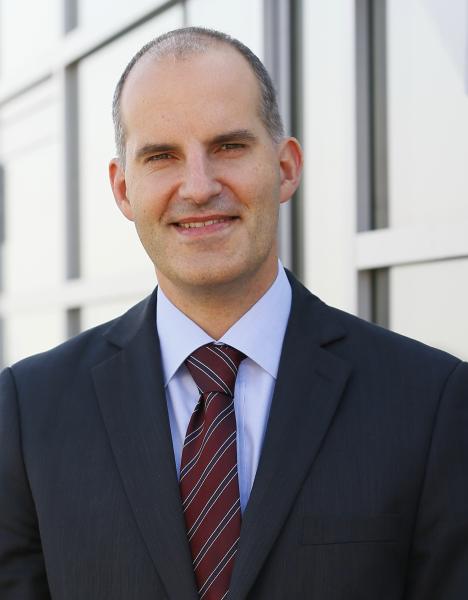
Martin Kern was appointed Director of the EIT on 23 August 2019. He is responsible for leading the activities of the Headquarters and coordinating collaboration among the Knowledge and Innovation Communities, and he heads the EIT's Management Team.
Downloads: Biography of Martin Kern and his photo.
The EIT is funded by the European Union through Horizon Europe, the EU’s key funding programme for research and innovation for 2021 to 2027.
The budget for the EIT during this period is approximately €3 billion.
Click here for further information on the EIT funding model.
The EIT funds Knowledge and Innovation Communities up to a maximum of 25 per cent. This funding is leveraged by the EIT by incentivising Knowledge and Innovation Community partners to invest in innovation and provide the remaining 75 per cent funding needed for their activities. With the 25 per cent seed funding, the EIT enables the Knowledge and Innovation Communities to attract capital from industrial partners and private investors.
The amount of funding that the EIT spends on administration at the EIT Headquarters is less than 3 per cent of its budget.
To get involved:
- Visit the opportunities page for the latest openings and programmes.
- Explore the events page for details of upcoming events.
- Support and vote in the annual EIT Awards; information on the EIT Awards and the most recent winners can be found here.
A Knowledge and Innovation Community (KIC) knits together different sectors, countries and disciplines. How is this achieved physically? The Innovation Hub is an EIT invention – and one of the EIT’s primary features.
Innovation Hubs are the main instrument for managing activities and knowledge flows. Each KIC has regional Innovation Hubs with partners in close proximity, which is essential for facilitating collaboration among members of the regional community. Innovation Hubs are the focal point for the KICs’ activities within these areas of focus. Innovation Hubs build on the existing labs, offices or campuses of some of the KIC’s core partners, which serve as clusters for a particular region, discipline or task. There, they bring together people and teams from across the knowledge triangle (education, business and research) to come up with ideas, projects and other initiatives.
To discover EIT Community locations near you, contact details, and information about the services we and our partners can offer you, click here.
 Share this page