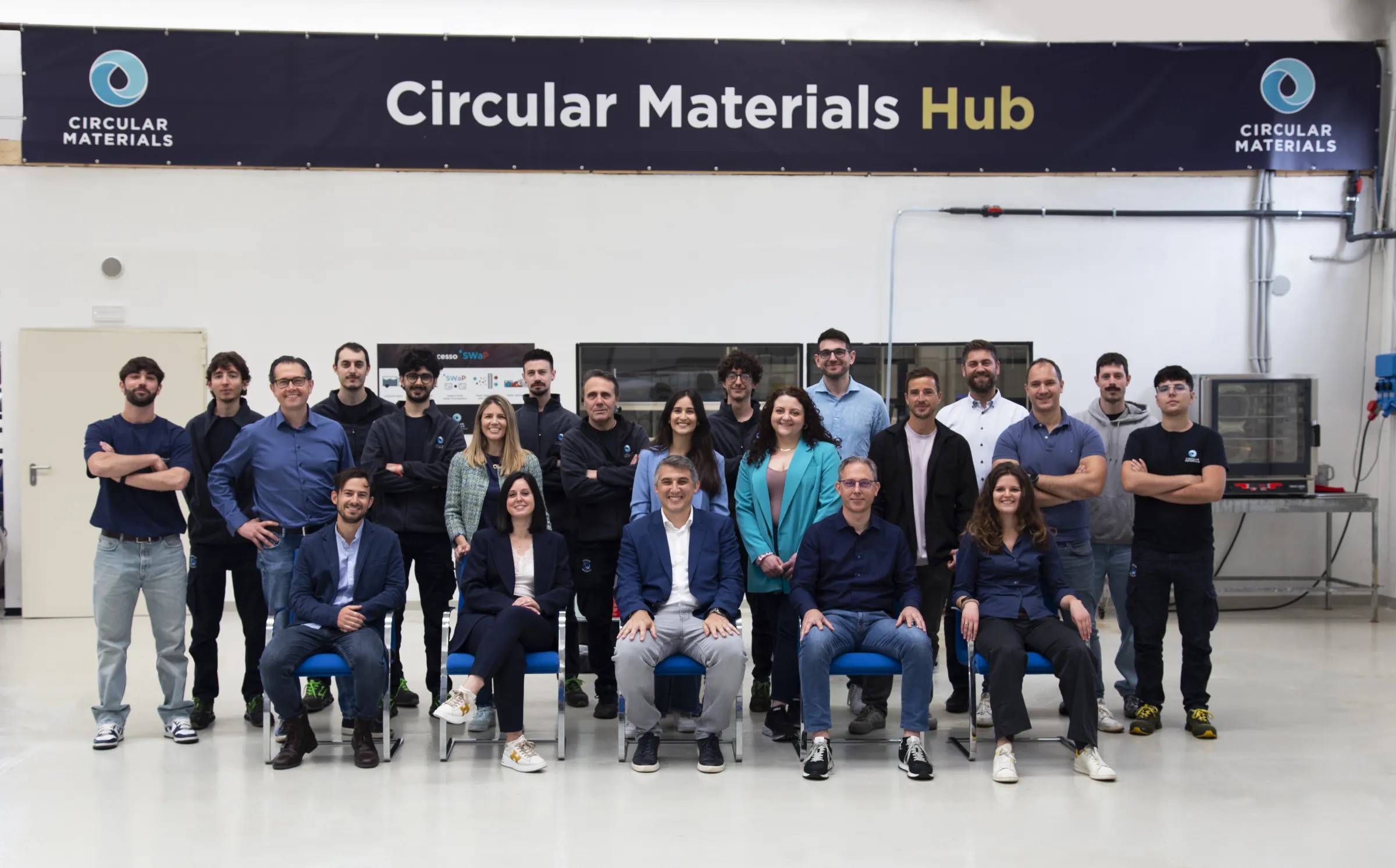
With support from EIT RawMaterials, Circular Materials has scaled its patented Supercritical Water Precipitation technology for recovering critical and strategic raw materials from industrial wastewater.
Every year, thousands of tonnes of nickel, copper, chromium and platinum group metals (PGMs) such as ruthenium leave European industrial facilities dissolved in wastewater. Treated as hazardous liquid waste, these metals are chemically complex, stubbornly resistant to conventional recovery methods, and typically end up as sludge in landfill. This represents a costly loss for both industry and Europe's raw materials security.
Closing that gap is the mission of Circular Materials, a cleantech startup based in Padua, northern Italy. With support from EIT RawMaterials, the company has scaled its patented SWaP™ (Supercritical Water Precipitation) technology, unlocking a new route to recovering critical and strategic raw materials from a waste stream that industry has long struggled to valorise.
SWaP™ works by controlling the behaviour of water under supercritical conditions — above 374°C and 221 bar — at which water's chemical and physical properties change fundamentally. Under these conditions, valuable metals can be separated and precipitated out of even highly complex industrial wastewater streams, including those that conventional recovery technologies cannot economically treat.
The results speak for themselves. Circular Materials' Padua plant is the first facility of its kind in Europe to achieve End-of-Waste (EoW) certification, and the company has been recognised as a Strategic Project under the EU's Critical Raw Materials Act (CRMA).
With a single process and a single technology, we are capable of processing hundreds of waste matrices, from different industries among which surface treatment, spent electrolytes and pharmaceutical. Every tonne of critical metals recovered from wastewater is a tonne Europe no longer needs to import and will not go in a local landfill or body of water.
Marco Bersani, CEO and Co-founder of Circular Materials
EIT RawMaterials support in action
EIT RawMaterials has supported Circular Materials through a SAFE Agreement of €1.5 million via the ERMA Booster Call. The investment is enabling the first replication of the SWaP™ technology at scale, at a new recovery facility under development in Ferrara, Italy, due to launch by 2027. Circular Materials has since become an Associate Partner of EIT RawMaterials.
The Circular Materials team identified a real gap in Europe's critical raw materials supply chain and built an innovative, commercially viable solution to close it. Recovering strategic metals from industrial wastewater that would otherwise be lost, that is exactly the kind of innovation Europe needs right now.
Valentina Anzoletti, Business Development Manager, EIT RawMaterials
Founded in 2019, Circular Materials has scaled steadily from prototype to industrial deployment. In 2024, the startup commissioned its first industrial facility in Padua, demonstrating that SWaP™ is viable at scale. Earlier this year, the plant achieved End-of-Waste (EoW) status under the EU Waste Framework Directive, which confirmed that materials recovered at the facility qualify as secondary raw materials ready to re-enter the supply chain. It is the first facility of its kind in Europe to achieve this status for critical raw materials recovered from industrial wastewater.
In March 2025, Circular Materials was also selected as a Strategic Project under the CRMA, as part of the RECOVER-IT project. The designation gives the startup access to accelerated permitting and direct engagement with the European Commission on scaling recycling and refining initiatives across member states.
What's next: scaling up in Ferrara
The next milestone is the Ferrara recovery facility, scheduled to launch in 2027. Once operational, the site will treat 20,000 tonnes of industrial wastewater and recover more than 1,000 tonnes of critical and strategic raw materials every year.
Beyond its own output, Ferrara is designed to serve as a blueprint — a replicable model for a wider network of recovery hubs across the EU and beyond, turning what was once industrial waste into a dependable domestic source of the metals Europe needs most.


 Share this page


