 EIT Community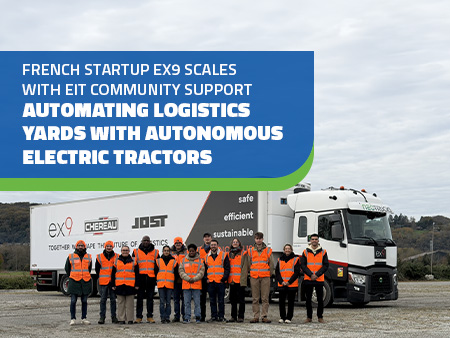
French startup ex9 is automating trailer movements at industrial sites using autonomous electric yard tractors, with support from the EIT Community helping the company strengthen its strategy for growth.
At Europe’s logistics hubs, movement never stops. Day and night, yard tractors shuttle trailers across industrial sites between warehouses, loading docks and production lines. The work is essential to keeping supply chains running, yet it often goes largely unnoticed.
Despite its importance, yard logistics often still relies on manual operations but labour shortages, rising operating costs and safety risks are placing increasing pressure on companies to modernise these operations.
A New Approach to Yard Logistics
For Ksenia Duarte, this overlooked part of logistics revealed an opportunity for transformation. The repetitive and controlled nature of yard operations makes them well suited to automation technology.
In 2021, Duarte co-founded ex9 in France to automate yard logistics using autonomous electric yard tractors designed for closed industrial environments. The company develops systems that move trailers automatically within logistics yards, manufacturing plants and distribution centres, helping operators manage trailer movements more efficiently.
Duarte previously worked on autonomous driving technologies, initially focusing on robotaxis and automated public transport. They saw that industrial yards – with predictable routes and controlled environments – offered a practical place to deploy this technology.
Automating Yard Operations
At many sites, yard operations can be inefficient: trailers may sit idle or be difficult to locate, driver no-shows can disrupt operations and congestion during peak periods can cause bottlenecks.
ex9’s system addresses these challenges by automating trailer movements using autonomous electric tractors. The system allows vehicles to move and position trailers automatically. The company reports a 99% success rate in automated coupling and docking.
Early deployments suggest sites can reduce operational costs by up to 30%, while electric vehicles can cut CO₂ emissions by as much as 94% compared with diesel-powered yard trucks, depending on fleet size and operating conditions.
Strategic Support from the EIT Community
As ex9 began preparing for international growth, Duarte joined Rocket Up 2025, a go-to-market programme for women-led startups delivered by EIT Community Supernovas. The programme helps founders refine their market strategy and prepare for expansion.
There are so many opportunities as a startup. Chasing them all is the fastest way to lose focus. Rocket Up helped us structure our thinking and plan our expansion intentionally.
Ksenia Duarte, co-founder of ex-9
Through mentoring, expert advice and access to the wider EIT innovation ecosystem, ex9 refined its strategy for entering the UK market and strengthened its investor readiness. Duarte also connected with industry experts and partners through initiatives such as the EIT Hub UK and Calling2Scale UK programme.
Moving from Proof of Concept to Deployment
After several years of building the business independently, the company closed a pre-seed funding round – an early stage of startup investment – in early 2025. Later that year, the preparation translated into visibility: during the Rocket Up graduation event at Slush in November, ex9 won the programme’s final go-to-market pitch.
Today, ex9 is moving from proof of concept to early pilot deployments of its technology. More than 30 industrial sites expressing interest and a €0.6 million project with DHL helping validate early commercial traction.
As these pilots progress, ex9 is continuing to advance its technology as it moves towards wider adoption in industrial yard operations. Through programmes and connections within the EIT Community, Duarte has also expanded the company’s network within Europe’s innovation ecosystem.

 Share this page


