Record 560 girls take on space debris in Europe's push to close the STEM gender gap
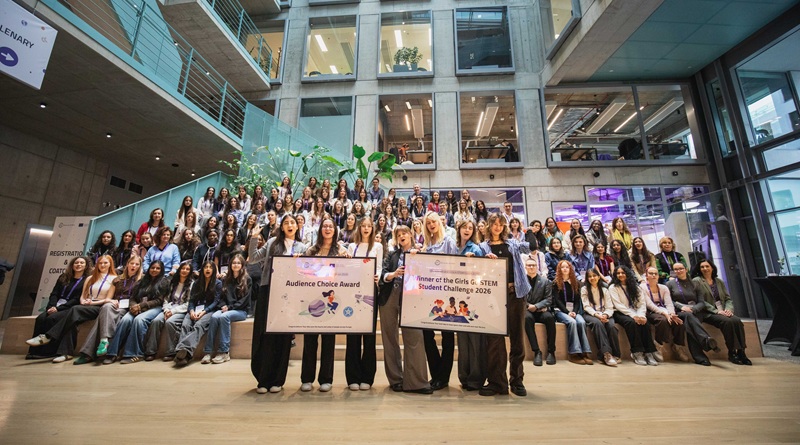
A record 560 girls aged 14 to 19 took on space debris in this year’s Girls Go STEM Student Challenge, and the EIT Women and Girls in STEM Forum in Prague celebrated their best ideas on 26 November. The winning team is heading to CERN, the European Organization for Nuclear Research near Geneva.
The Student Challenge is the annual competition of Girls Go STEM, an initiative that encourages girls to explore science, technology, engineering and mathematics (STEM). This year, it asked students to come up with ways to tackle space debris and invited the strongest teams to present their ideas at the Forum.
An expert jury chose 28 national winning teams from 200 applications. They travelled to Prague with their teachers and mentors, and the three finalists pitched live on stage. The winning team, Ablation Domination from Lithuania, proposed a satellite laser that clears itself away: when its mission ends or if it breaks, an onboard laser turns it into harmless gas, so it never becomes space debris. Their prize is a trip to CERN, where they will meet scientists and see the world's largest particle physics laboratory.
More than 5,800 people took part in the online vote, each able to choose up to three teams. Team Artemis from Türkiye received the most votes and won the Audience Choice Award, sponsored by ENHANCE, an alliance of European technical universities. Their idea, SUTURA-RW, is a beetle-inspired housing that keeps broken satellite parts connected, so fewer fragments escape and become debris. Their prize is a visit to an ENHANCE university of their choice.
Why space, and why girls?
Women make up only about 30% of the workforce in public space organisations worldwide, according to a 2024 study by the United Nations' Space4Women initiative. Many of these jobs need STEM skills, so reaching the missing talent starts at school.
At CERN I see people of every background working together to answer some of the biggest questions about our universe. STEM careers are open to anyone, including girls, and every young person deserves to picture themselves as a scientist. That's why I am proud to be here and celebrate this shared commitment with EIT.
Dr. Adelina Lintuluoto, applied physicist and science communicator at CERN Education
About Girls Go STEM
Girls Go STEM is a European educational initiative led by EIT, coordinated by EIT RawMaterials and supported by the European Commission. Launched in 2020, it inspires girls aged 14 to 19 to pursue STEM studies and careers through free online courses, hands-on activities and the Student Challenge, and has trained more than 100 000 students across 37 countries.

 Share this page


