Navarra 360º Unveils First-Year Results
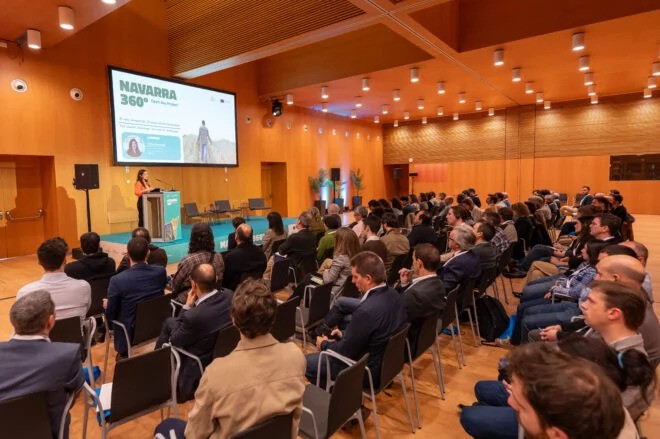
The Navarra 360º project, led by EIT Food, presented at the Navarra Conference Centre and Auditorium (Baluarte) the results of its first year of implementation, as well as its roadmap for 2026–2027.
The “Open Day” brought together a broad representation of its members (partners, farmers, trainers and technical measurement staff), including Danone Ecosystem, Intermalta, Alpro and Cargill, among others. All of them shared progress updates and reinforced collaboration at regional level.
During its first year of development, Navarra 360º has advanced a transition model towards regenerative agriculture with quantifiable and verifiable results. The initiative currently covers more than 4 000 hectares under regenerative transition, with 38 farmers involved and more than 60 individual transition plans designed and implemented.
The technical and scientific dimension has been one of the project’s key pillars. In 2025 alone, more than 200 sampling points were carried out and the number of full analyses exceeded 700, including soil fertility, carbon stock and microbiology assessments. This makes it possible to establish a solid research baseline and measure the real evolution of impact in subsequent campaigns. In parallel, 24 hours of specialised training were delivered and more than €96 000 in premiums linked to the adoption and verification of regenerative practices were channelled.
Another distinctive element of Navarra 360º is the implementation of a robust Monitoring, Reporting and Verification (MRV) system integrating different methodologies for calculating emissions and carbon sequestration. In this regard, the project combines digital tools for data collection and aggregation with quantification models such as Cool Farm Tool and DNDC, as well as real soil carbon measurements, thereby reinforcing the credibility and comparability of results.
Navarra 360º is part of EIT Food’s Regen Ag Portfolio, a European strategy that promotes territorial or Landscape Projects as a pathway to accelerate the transition towards more resilient agrifood systems.
EIT Food is promoting in Navarra a resilient agriculture that regenerates soils, strengthens farmers and enables the production of quality food in a sustainable and profitable way.
EIT Food’s Director of Agriculture, Elvira Domingo
Partners And Measurement Systems
Collaboration between local stakeholders and supply chain partners was presented as a core element of the project. Intermalta, Cargill, Danone Ecosystem and Alpro, all sourcing raw materials from the region, were described as working together to develop a supply chain framework based on verifiable data, aimed at strengthening agricultural resilience.
During the roundtable, Ana Martín (Intermalta), Gupse Süren (Cargill) and Alejandro de Frías (Danone) explained that the project aligns calculation methodologies and structures data to enable impact quantification. De Frías noted that Navarra 360º enhances the resilience and competitiveness of Danone’s supply chain in a context of increasing climate and market volatility, adding that territorial collaboration with farmers supports long-term sustainability, transparency and value creation.
Martín and Süren stressed that direct engagement with farmers is essential to the success of such initiatives. They highlighted that on-the-ground collaboration, practical agronomic support and credible measurement systems are key to scaling regenerative agriculture and enabling farmer-led transitions.
The project’s technical dimension was also addressed, with Marie Liétad-Montigny (IMPROVIN) and Marie Marion (REGROW) outlining the monitoring platform, while Peterson’s agronomists, Roberto Rosales and Amaia Marruedo, presented the field support protocol and the system used to monitor implemented practices.
Farmers And Trainers
The event at Baluarte concluded with contributions from farmers and trainers (INTIA, Neiker, the Public University of Navarra (UPNA), Agracon, Sustraiak and Suelo Activo). All of them stressed the importance of applied knowledge, continuous training and technical support to advance the transition.
Looking ahead to 2026–2027, Navarra 360º plans to formalise the territorial model, strengthen its scientific base with new sampling campaigns and activate specific pilots focused on biodiversity, sustainable fertilisation and the social dimension of the transition. In addition, the project will assess continuity scenarios to maintain and scale its impact beyond 2027.
With these lines of work, Navarra 360º consolidates its position as a territorial innovation laboratory in regenerative agriculture, with a clear vocation for learning, rigorous measurement and European scalability.


 Share this page


